The Stoichiometry of Flavor: Why Your Single-Cup Brew is Mathematically Watery
Update on Jan. 31, 2026, 7:20 p.m.
In the 1950s, the Coffee Brewing Institute (a precursor to today’s Specialty Coffee Association, or SCA) undertook a massive scientific study to quantify “good” coffee. They didn’t rely on subjective taste tests; they relied on chemistry. The result was the “Golden Cup Standard,” a set of parameters defining the ideal balance of strength and extraction.
At the heart of this standard is a simple ratio: 1:15 to 1:18. This means for every 1 gram of coffee grounds, you need 15 to 18 grams of water. This ratio is not a suggestion; it is a stoichiometric requirement to dissolve the correct percentage of soluble solids (ideally 1.15% to 1.35% Total Dissolved Solids) from the bean matrix.
However, the modern “single-serve” revolution has largely ignored this fundamental law of physics. Millions of consumers begin their day with a beverage that is technically “hot brown water,” not because of the quality of the bean, but because of a catastrophic failure in volumetric math. To understand why your morning cup lacks soul, we must look at the numbers.
The Golden Cup Standard: A History of Ratio
The science of extraction is governed by diffusion. When hot water contacts coffee grounds, it dissolves compounds in a specific order: acids and fats first (sour/fruity), sugars next (sweet/bodied), and plant fibers last (bitter/astringent).
If you use too little water (a 1:10 ratio), the water becomes saturated before it can extract the sugars, leading to a sour, under-extracted cup. If you use too much water (a 1:25 ratio), the water continues to pull out bitter, woody tannins long after the good flavors are gone. The “Golden Window” of 1:15-1:18 is where the sugars are maximized and the bitterness is minimized. This is the thermal equilibrium of a perfect brew.
The Dilution Error: Analyzing the 1:40 Anomaly
The structural flaw in most single-serve pod systems is physical capacity. A standard plastic coffee pod holds approximately 10 to 12 grams of coffee.
Now, consider the user behavior. A consumer desires a large “travel mug” size coffee to last through their commute—typically 12oz or 14oz (approx. 415ml/415g).
Let’s do the math: * Solute (Coffee): 11g * Solvent (Water): 415g * Ratio: 1:37.7
This ratio is mathematically disastrous. You are pushing nearly three times the recommended amount of water through a fixed amount of coffee. The first 5 ounces extract the flavor; the remaining 9 ounces are simply diluting that flavor with over-extracted, bitter water. It is physically impossible to brew a strong 14oz cup with a 11g pod. The math does not allow it.
Case Study: Volumetric Correction (Tastyle Model 8)
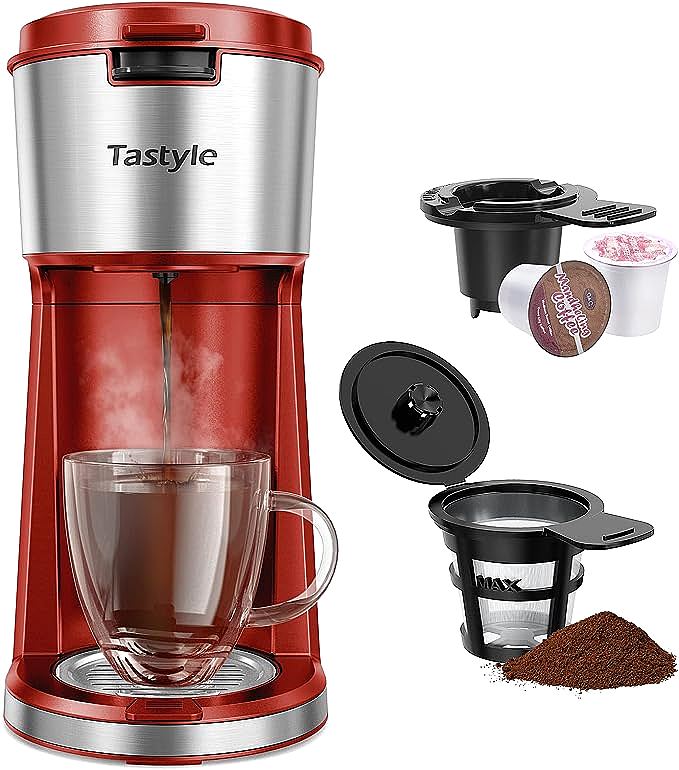
The engineering solution to this problem is not “better pods” or “hotter water”—it is simply volume. This is where the Tastyle Single Serve Coffee Maker (Model 8) provides a relevant case study in corrective engineering.
Recognizing the “Dilution Error,” this unit abandons the standard constraint of the pod adapter when used in “Grounds Mode.” It utilizes a 25-gram (0.9 oz) reusable filter basket.
Let’s re-calculate the stoichiometry for a 14oz brew using this hardware: * Solute (Coffee): 25g * Solvent (Water): 415g * Ratio: 1:16.6
By increasing the physical capacity of the brew basket, the machine lands squarely within the SCA’s Golden Ratio (1:15-1:18). This validates the thesis: to brew a large cup of coffee that retains proper strength (TDS), the machine must physically accommodate a larger mass of dry matter.
Pulse Dynamics: The Physics of “Bold”
Beyond ratio, extraction is influenced by Turbulence and Contact Time. In fluid dynamics, turbulence increases the rate of mass transfer. Standard single-serve machines rely on a continuous, laminar flow—water rushes through the puck in a straight line, often channeling (finding the path of least resistance) and leaving some grounds dry.
The “Bold” setting found on units like the Tastyle utilizes a Pulse Brewing Algorithm. Instead of a continuous stream, the pump cycles on and off.
1. Phase 1 (Bloom): A small amount of water wets the grounds, releasing CO2 (degassing).
2. Phase 2 (Pulse): Water is injected in bursts. This agitation creates turbulence within the basket, ensuring all grounds are saturated.
3. Phase 3 (Soak): The pauses allow for osmotic pressure to draw solubles out of the center of the coffee grind, rather than just washing the surface.
Thermal Consistency
The final variable is heat. Extraction efficiency drops precipitously below 195°F. Small heating elements often struggle to maintain temp at high flow rates. The target temp for the Tastyle is calibrated to 185°F+ at the exit point, ensuring that even as water travels through the air to the cup, the slurry temperature remains active enough to dissolve the necessary oils.
Conclusion: Mathematical Certainty
There is no magic in coffee brewing. It is a strict chemical equation of mass, time, and temperature. The dissatisfaction many feel with single-serve brewers is usually a dissatisfaction with the 1:40 ratio. By selecting hardware that allows for volumetric correction—specifically, baskets large enough to hold 25g of grounds—the user aligns their equipment with the laws of physics, ensuring that convenience does not come at the cost of concentration.