The Analog Social Network: Rediscovering the Power of Wired Audio Sharing
Update on Dec. 21, 2025, 6:40 a.m.
We live in an era of solitary listening. Headphones are often tools of isolation, designed to create a private bubble in a public world. Sharing music usually means sending a Spotify link, not listening together in real-time. Wireless technologies like Bluetooth “Dual Audio” exist, but they are often plagued by latency, compression, and pairing headaches.
In this context, the return of physical audio sharing—the “Daisy Chain”—is a refreshing reminder of the reliability of analog tech. The SharePort technology found in the OneOdio A71 headphones represents a simple, elegant solution to a social problem. It turns the headphone from a receiver into a transmitter, creating a physical social network of sound.
The Circuitry of Sharing
How does SharePort work? It relies on a clever bit of internal wiring.
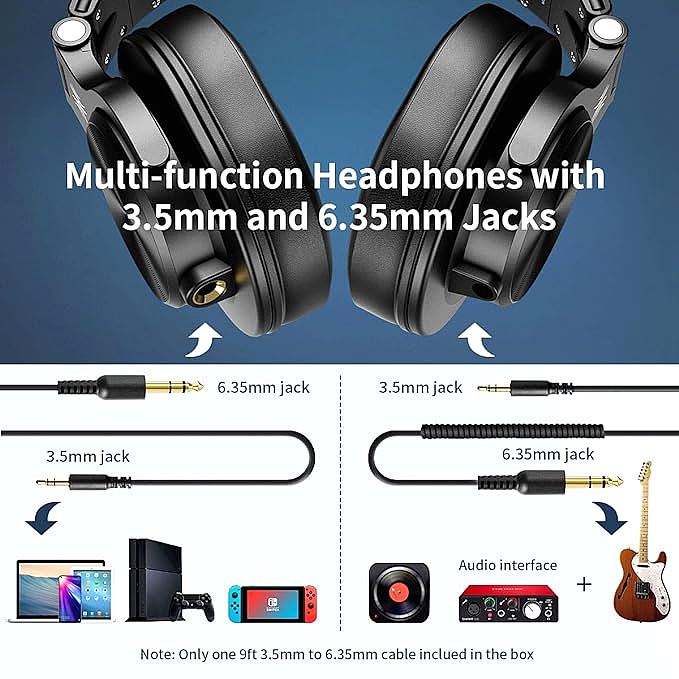
Most headphones have one input jack. The A71 has two: a 3.5mm jack and a 6.35mm (1/4 inch) jack.
* Input Agnostic: The internal circuit connects these two ports in parallel. Audio entering one port is automatically routed to the drivers and to the other port.
* The Bridge: This means the second port effectively becomes an output. You can plug a second pair of headphones into the vacant jack, and both listeners hear the same source.
This “Daisy Chaining” can theoretically continue (source -> Headphone A -> Headphone B -> Headphone C), limited only by the impedance load on the amplifier. It requires no batteries, no pairing codes, and no software updates. It is pure physics.
The Professional Necessity: Zero Latency
For casual listening, latency (the delay between source and sound) is annoying. For professionals, it is a dealbreaker. * DJing: Two DJs performing back-to-back need to cue tracks simultaneously. Bluetooth introduces a 100-200ms delay, which makes beatmatching impossible. Wired sharing via SharePort is instantaneous. * Studio Monitoring: A producer and an artist need to hear the same mix while recording. The SharePort allows them to link up without needing a complex headphone amplifier distribution system.
This feature transforms the A71 from a consumer gadget into a utilitarian studio tool. It solves the “monitoring problem” with a simple cable.
The Universal Translator: Dual-Duty Cables
Beyond sharing, the dual-jack design solves the “dongle hell” of modern audio. Professional gear (mixers, amps, guitars) uses 6.35mm jacks. Consumer gear (phones, laptops) uses 3.5mm jacks. Usually, this requires an easy-to-lose adapter.
The A71 integrates the adapter into the cable itself. The coiled cable has a 3.5mm plug on one end and a 6.35mm plug on the other. * Reversibility: By flipping the cable, you can connect the headphones to either a phone or a mixer without an extra adapter. * Locking Mechanism: This design acts as a physical protocol converter. It bridges the gap between the “Pro Audio” world and the “Consumer Audio” world.
Conclusion: The Intimacy of the Wire
There is an intimacy to wired sharing that wireless cannot replicate. Being physically tethered to another person creates a shared space. You are literally connected.
Technology often seeks to remove friction, but sometimes, the friction (the wire) is the point. Features like SharePort in the OneOdio A71 remind us that the most robust solutions are often the simplest. In a world of fragile connections, the wire remains the strongest link.