The Art of Disconnecting: Why Standalone Wearables Are Making a Comeback
Update on Dec. 21, 2025, 6:34 a.m.
We live in the age of the cloud. Our music, our podcasts, and our audiobooks live on servers thousands of miles away, streamed instantly to our devices via an invisible tether. This convenience is undeniable, but it comes with a hidden cost: the necessity of the smartphone. To listen, we must carry the portal to the internet with us.
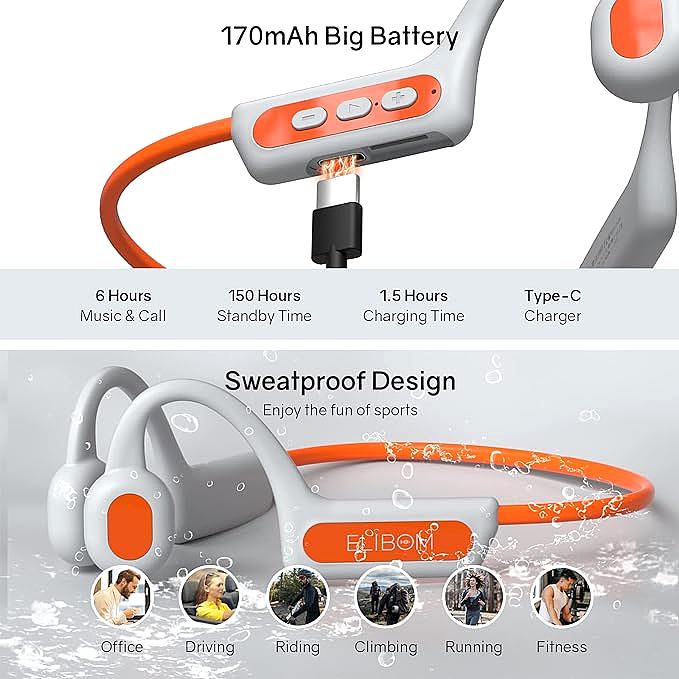
For the runner, the climber, or the gym-goer, the smartphone is a burden. It is heavy, it bounces in pockets, and worse, it is a constant source of distraction. A notification ping can shatter the mental state of “flow” instantly. This friction has sparked a counter-trend: the return of standalone functionality. Devices like the ELIBOM BC lite, with its built-in, expandable MP3 player, represent a desire to reclaim the purity of the activity by severing the digital umbilical cord.
The Cognitive Cost of Connectivity
Why is leaving the phone behind so liberating? It comes down to Attention Economy. When you exercise with a phone, even if it is just for music, you are carrying a device designed to capture and monetize your attention.
- The Phantom Vibration: The mere presence of a phone increases cortisol levels and anticipation of interruption.
- The Algorithm: Streaming services are designed to keep you engaging with the screen (skipping tracks, liking songs), breaking your physical rhythm.
By offloading the audio to a local storage device—like the 128GB capacity supported by the ELIBOM BC lite—you create a “walled garden” of content. You curate your playlist in advance. Once the workout starts, there are no skips, no ads, and no notifications. It is just you, your body, and the music. This creates a psychological environment conducive to deep focus and mindfulness.
The Physical Freedom of “Phone-Free”
Beyond the psychological benefits, the physical advantages of standalone wearables are immediate. * Weight Distribution: Running dynamics are sensitive to asymmetry. A heavy phone in one pocket or an armband throws off balance. Removing 200g of glass and metal makes a noticeable difference in gait and comfort. * Risk Mitigation: In rugged environments like rock climbing or trail running, a phone is a fragile liability. Leaving it in the car or locker eliminates the risk of smashing an expensive screen against a rock.
The ELIBOM BC lite’s capability to function as an independent MP3 player transforms it from a mere “accessory” (dependent on a host) to a “primary device.” It empowers the user to move with absolute freedom.

The Reliability of Local Storage
In an era of 5G, we forget that connectivity is not ubiquitous. Trail runners in deep valleys, hikers in remote wilderness, or even gym-goers in concrete basements often face dead zones. Streaming fails in these edge cases.
Local storage is infrastructure-independent. Your music is physically present on the flash memory of the device. It does not buffer. It does not degrade in quality. It works perfectly whether you are in downtown Manhattan or on the Pacific Crest Trail. This reliability is a core tenet of serious outdoor gear: it must work when the grid does not.
Conclusion: Selective Connectivity
The future of wearable technology is not about being connected all the time, but about being connected on our own terms. We are seeing a divergence in hardware design: some devices are becoming thinner clients of the cloud, while others, like the ELIBOM BC lite, are regaining their independence.
This shift acknowledges that sometimes, the best way to connect with yourself is to disconnect from everything else. By integrating a simple, robust MP3 player into a modern bone conduction headset, we get the best of both worlds: the advanced safety of open-ear audio and the focused simplicity of a pre-internet Walkman. It is a technological step forward that feels like a breath of fresh air.