Beyond Pixels: Why Thermal Sensitivity Trumps Resolution in Diagnostics
Update on Jan. 31, 2026, 8:02 p.m.
When most people pick up a thermal imaging camera for the first time, their initial reaction is often confusion. Accustomed to the crystal-clear, multi-megapixel displays of modern smartphones, the 80x60 pixel grid of an entry-level thermal imager can seem jarringly low-fi. However, judging a thermal imager by the standards of visible light photography is a fundamental misunderstanding of the tool’s purpose.
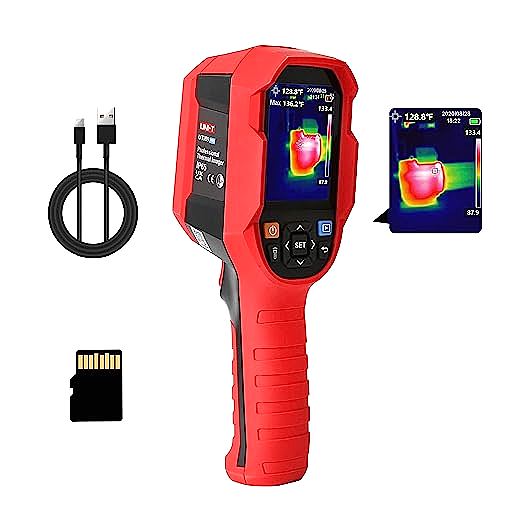
A thermal imager is not a camera in the traditional sense; it is a non-contact data acquisition device. It does not capture light; it maps heat. Understanding the physics behind this distinction—specifically the interplay between resolution and thermal sensitivity (NETD)—is the key to unlocking the diagnostic power of devices like the UNI-T UTi89 Pro.
The Pixel Grid Reality: Data Points, Not Pictures
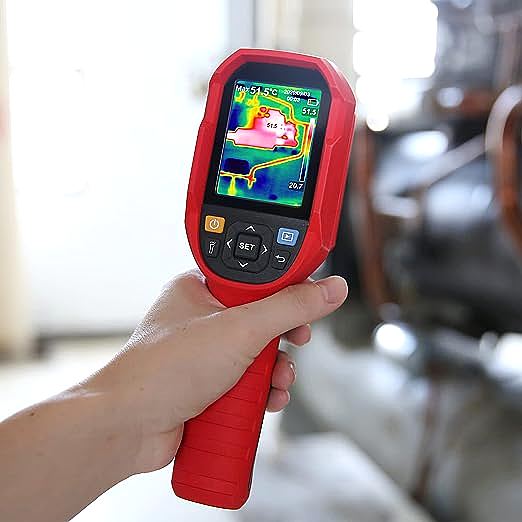
In the world of thermal imaging, resolution refers to the number of individual temperature measurement points on the sensor. An 80x60 resolution means the sensor has an array of 4,800 individual detectors. While 4,800 pixels is low for a photograph, it is substantial for a thermometer. Imagine holding 4,800 laser thermometers simultaneously and getting an instant readout from all of them at once. That is the true function of the imager.
According to 2021 research by the American Society for Nondestructive Testing (ASNT), for general diagnostic tasks such as locating an overheating breaker or a missing patch of insulation, high spatial resolution is often secondary to the ability to detect thermal contrast. The goal is not to read the text on a circuit breaker label but to identify which breaker is glowing white-hot compared to its neighbors. The 4,800 data points of the UNI-T UTi89 Pro are more than sufficient to create this “thermal map” of anomalies.
The Hero Spec: Understanding NETD
If resolution is the “sharpness” of the image, NETD (Noise Equivalent Temperature Difference) is its “depth.” NETD measures the smallest temperature difference the camera can distinguish. It is typically expressed in milliKelvins (mK).
The UNI-T UTi89 Pro boasts an NETD of 150mK. This means it can detect a temperature difference as small as 0.15°C. This sensitivity is the device’s true superpower. Even with a lower pixel count, a high-sensitivity camera can reveal: * Moisture Intrusion: The slight cooling effect of evaporation on a wall, which is invisible to the eye. * Drafts: Subtle air leaks around window frames that differ only slightly from the ambient wall temperature. * Early-Stage Electrical Faults: Connections that are just beginning to degrade and heat up, long before they reach a critical failure point.
A camera with high resolution but poor sensitivity (high NETD) would produce a sharp image but might miss these subtle thermal signatures entirely, rendering it useless for preventative maintenance.

The “Blurry” Myth and the Auto-Scaling Trap
A common frustration for new users is an image that appears washed out or lacks contrast. This is rarely a fault of the resolution but rather a misunderstanding of “Level and Span.”
Thermal cameras automatically adjust their color palette to map the coldest temperature in the frame to one color (e.g., blue) and the hottest to another (e.g., red or white). This is called “auto-scaling.” * The Trap: If you point the camera at a scene containing a scorching hot object (like a 150°F pipe) and a room-temperature wall (70°F), the camera stretches its color palette across that huge 80-degree range. Subtle differences in the wall temperature (like a 2-degree cold spot) effectively disappear because they represent such a tiny fraction of the total color scale. * The Solution: To see the detail, you must exclude the extreme outlier temperatures from the frame. By moving closer to the area of interest—the wall itself—the camera effectively “zooms in” its thermal scale, dedicating its entire color palette to the smaller temperature range. Suddenly, the “blurry” image resolves into a clear map of thermal patterns.
Applications Over Aesthetics
When deploying a thermal imager in the field, the priority is data reliability. The ruggedness of the tool often outweighs the pixel count of the screen. In industrial environments, a device like the UNI-T UTi89 Pro, with its IP65 rating and 2-meter drop protection, ensures that the thermal data is accessible even in harsh conditions where delicate, high-resolution smartphone attachments might fail.
Whether you are auditing a server room for hotspots or checking a breaker panel in a dusty workshop, the ability to rely on the tool is paramount. The 9Hz refresh rate provides smooth enough feedback for scanning, allowing the user to pan across large areas quickly to locate the “hotspot” before zeroing in for a measurement.
In conclusion, reading a thermal imager requires a shift in perspective. It involves looking past the jagged edges of the pixels to interpret the color gradients that represent heat. By understanding that an 80x60 sensor is actually a sophisticated array of 4,800 thermal data points with high sensitivity, users can leverage these tools to see the invisible and diagnose problems that lie hidden beneath the surface.
Ready to start your thermal audit? Ensure you are interpreting your data correctly to make informed maintenance decisions.